Hello Hailo !
I am trying to run a custom YoloV7 on a Hailo H8 card using the C++ API but it clearly does not work. I will detail the process I followed :
-
From my onnx model, I got a .hef file using DFC 3.33 using the 3 commands
hailo parserhailo optimizeandhailo compile. At this step, there is one issue that I can deal with : during the parsing, the output is done before the detection head (so after the last 3 sigmoids). Therefore I have 3 outputs (for each anchors) instead of a single one. I have reimplemented the detection head in C++ but I wish it was not necessary. -
I use the C++ example async_infer_basic_example with a few modification :
- During model loading, I specify that I expect the output to be float (since those are sigmoid output) using
        for (const auto &output_name : infer_model->get_output_names()) {
            infer_model->output(output_name)->set_format_type(HAILO_FORMAT_TYPE_FLOAT32);
        }
- I fill the input buffer with the image in NCHW format without any conversion, that is, I have pixel value for each RGB channel (0-255) that I simply reorder
- After the inference, I apply the detection head to my output to obtain the box and apply the NMS manually
In the end, I obtain boxes around the persons (so it doesn’t seem random) but the boxes are never totally OK and some person are not detected at all as you can see here.
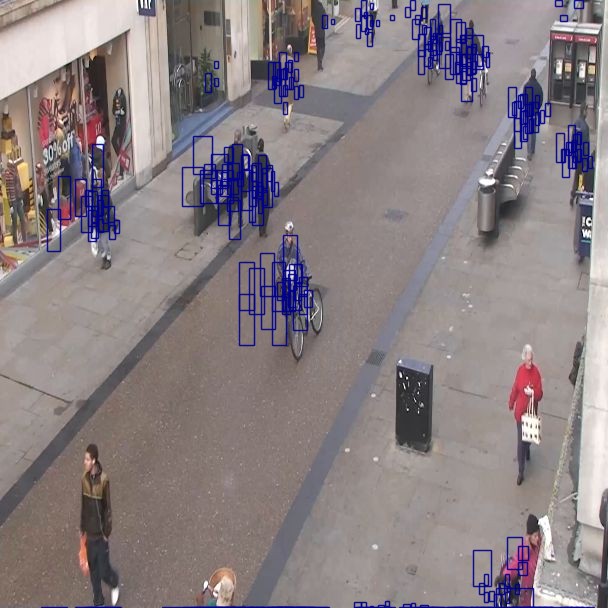
I don’t know if there was an issue during the onnx->hef process or in my value interpretation.
Thank you for your guidance ! 
PS: I did not intend to use Hailo Zoo because we have custom neural network model that will not be available in the Zoo which we want to run on Hailo card. This YoloV7 test is just first step to check if we could use Hailo cards in the future.